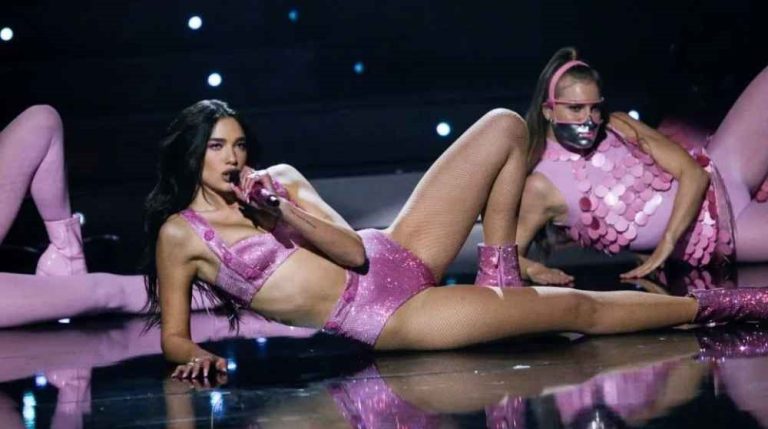
Katy Perry’s new release, “Daisies,” is a huge hit! She rocks a white dress while singing in a field of daisies and on top of a mountain, cradling her baby bump. She then strips down and goes completely nude in the water.
Perry first announced her pregnancy in March via her “Never Worn White” music video, in which she also showed off her baby bump. “Omg so glad I don’t have to suck it in anymore,” she tweeted after the reveal, “or carry a big purse.”
Read the full lyrics to “Daisies” below.
Told them your dreams,
and they all started laughing
I guess you’re out of your mind til it actually happens
I’m the small town
One in seven billion
Why can’t it be me
They told me I was out there
Tried to knock me down
Took those sticks and stones
Showed ’em
I could build a house
They tell me that I’m crazy
But I’ll never
let ’em
change me
Til they cover me in daisies,
daisies,
daisies
They said I’m going nowhere
Tried to count me out
Took those sticks and stones
Showed ’em
I could build a house
They tell me that
I’m crazy
But
I’ll never let ’em
change me
Til they
cover me in daisies,
daisies,
daisies
When did we all stop believing in magic
Why did we put
all our hopes in a box in the attic
I’m the long shot
I’m the Hail Mary
Why can’t it be me
They told me I was out there
Tried to knock me down
Took those sticks and stones
Showed ’em
I could build a house
They tell me that I’m crazy
But I’ll never let ’em
change me
Til they cover me
in daisies,
daisies,
daisies
They said I’m going nowhere
Tried to count me out
Took those sticks and stones
Showed ’em
I could build a house
They tell me that I’m crazy
But
I’ll never let ’em change me
Til they cover me in daisies,
daisies,
daisies
I’m the
small town
One in seven billion
Why can’t
it be me
They told me I was out there
Tried to knock me down
Took those sticks and stones
Showed ’em
I could build a house
They tell me that I’m crazy
But I’ll never let ’em
change me
Til they cover me in daisies,
daisies,
daisies
They said
I’m going nowhere
Tried to count me out
Took those sticks and stones
Showed ’em
I could build a house
They tell me that I’m crazy
But I’ll never let ’em
change me
Til they cover me in daisies,
daisies,
daisies
Stream and save “Daisies” here.
From Kesha and T-Pain, to Britney Spears and B.O.B., rap artist and producer, Mathieu Lepine, better known as “Billboard” has had his production and composition skills in the music industry since as early as 2010.With over 78 A-list music credits, Billboard is still very much immersed in the industry today, working with artists including The Game, Robyn, Ellie Goulding, Shakira, Dillon Frances, Chris Brown, Ariana Grande, and Selena Gomez.While silently producing in the background, his success behind these artists have allowed each to reach the pinnacles they have today. Music Industry Weekly spoke with Billboard on his origins in the industry and how in 2020, the industry has shifted to empowering women to become the next generation of producers.Music Industry Weekly: What first struck your interest in the music industry?Billboard: Listening to people like Pharrell, Timbaland, Bloodshy & Avant have such a huge impact on the music industry at the time was what started it for me. Hearing how they also approached “Pop” music with a different ear was very exciting. There was a point in the early 2000’s we’re everything sounded a bit too polite and proper and these guys just came in and switched it up. It definitely inspired me to try to do the same thing.
MIW: How would you describe the music industry you came into and the one you are currently in today (as of 2020)?Billboard: Nowadays you can be an independent artist who’s just starting and have a song on the radio, which is an amazing thing. The industry had to adapt to the new ways of making and releasing music. As a producer, it shows you that it’s important to work with any artist you like, whether they’re popular or not. Also, I feel like the music on the radio is more diverse compared to 10 years ago.
MIW: What do you mean by “more diverse”?Billboard: All genres can be mixed together, which means less “rules”. For a producer, this is exciting.
Has COVID-19 Changed the Industry for the Worst?
MIW: How has COVID-19 affected you personally as you are writing, producing, and working with talent?Billboard: It definitely has affected how I intend to work with people in the future, but the way I see it is that I am still able to make music, send it out with the hopes of collaborating that way. I tend to make a lot of music on my own in Montreal anyway. Since I won’t be able to travel to Los Angeles and collaborate with people, we’re gonna have to find a way to work via FaceTime, which is fine. I’m just grateful to be healthy and I get to make music for a living.
MIW: In what direction do you think the industry will move after this pandemic is over? Is this a change for the worst?Billboard: I think It might be for the better; artists will find new ways to get creative on their own. I’m sure a lot of great music will come out of It. I know I’ve been more resourceful since the pandemic has started.
MIW: Can you elaborate?Billboard: It has forced me out of my comfort zone and I think It’s a great thing. People will be more interested in how to put together a record, alongside writing and producing by themselves since they have no choice. I think we have to see the positive in all of this.
MIW: How have women taken control in the industry and how can this empowerment movement continue to grow?Billboard: We must continue to make room for women and not be afraid to collaborate. I would love to see more women producers. There are so few of them and I feel like it could definitely be a fresh air in a male dominated industry. I think the more we collaborate with them and the more success they have, the more It will inspire younger generations to do the same.
Through the Looking Glass
MIW: Share your experience working with the following artists during the production of these albums:
Selena Gomez and her album, Rare
My manager had set up a writing session with two other writers and another producer, Alex Hope. This was the first time I was able to collaborate with a female producer and it went great. I remember we were just vibing and having fun in the studio; the song came to life very quickly, In the first thirty-minutes of making the track, we had the chorus and it felt good. One of the songwriters in the session had a friend who knew Ms. Gomez and she said she could play her the song we did.
A month later, once I was back in Montreal, the team told me Ms. Gomez had recorded our song. It’s probably the fastest way a song of mine has landed on an album. It all happened so quickly.
Chris Brown and his album, Heartbreak On a Full Moon
It was a track I had done 3 years prior to that while I was on a songwriting trip in Kauai. A few people had written over it, but nothing stood out. Then somehow through my publisher, the track ended up in Chris Brown’s hand and 2 months later the song was out. It’s one of those crazy situations that was never planned.
This industry is full of surprises like this; you never know how a song can happen, which is why you can’t have too many expectations in this industry. If you do, you’ll be disappointed at every corner. You just have to see the big picture, keep going and every now and then you’ll get blessed with amazing opportunities.
Arianna Grande and her album, Dangerous Woman
We made this song at a songwriting camp 2 years prior to Dangerous Woman. I remember we had Rihanna in mind when we’re making it. We sent it out to her team and they really liked it, but then they came back saying Rihanna had passed on the song.
A year later, Peter Svensson (one of the songwriters on the song) was telling me he was going to begin work on Ms. Grande’s album with his team. A few months later, he came back and told me she loved the song and wanted it for her album, which was amazing news. I then flew to L.A. and Peter and I finished the song with the vocals she had recorded. Again I’m just grateful opportunities like this one happened.
Shakira and her album, Shakira
My publisher sent me to Barcelona in 2012 for a few days to work with Shakira, which was awesome. She was super energetic and into the music. It was amazing to see an artist this successful be so involved in the music, even after all these years.
She ended up extending my trip for 3 weeks, we were working on her single “La La La”, and she wanted to get it just right for the 2014 World Cup. The whole experience was unreal as a then 21-year-old, as it was my first time in Barcelona. I was going out to clubs with Shakira and her team. It’s a trip I’ll never forget.
Britney Spears and her album, Femme Fatale/Circus
Dr. Luke who at the time was working on Mrs. Spears’ album with Max Martin, flew me to LA to work specifically on this album. That’s how I had my “breakthrough” in the industry in 2011.
Meeting Britney was definitely a key moment at that point in my career. I remember we worked on “Hold It Against Me” for three weeks straight. Mrs. Spears came in and recorded her vocals really fast. In a few hours, the track was done. She’s a real professional.
After the recording, Max Martin, Dr.Luke and I spent 3 weeks finishing the song to get it just right and how we wanted it. That whole process showed me how dedication is key in this business.
A few months later, I went back to L.A. to work on the album. It was a two month period of just music everyday. All the producers and songwriters, collectively, were pushing and encouraging each other creatively. We wanted to pay justice to Mrs. Spears and the high level production she was known for. I ended up having four songs and two singles on that album.
From that point on, my entire career changed and that’s when I decided to move to L.A.
The Voice Winner Chevel Shepherd says, “I grew up listening to these powerhouse country singers who were so savvy and knew exactly what they wanted to say in their music. Songs that in just three minutes have the ability to transport you into these other worlds with characters that feel so real.”
“Southern Boy” is written by Cassidy Lynn Alexander and Kellys Collins, the new single overflows with confidence and style. Shepherd explains, “I have grown up in a town on the outskirts of Farmington, New Mexico, with a population of less than 1,500 people, so I know a lot of those characters, yet at the end of the day, I do see myself with someone who has that southern charm in ‘Southern boy’.”
Now more than ever, music and entertainment are helping to spark positivity across the world during an uncertain time. Record labels throughout the world are facing a triple danger from the fallout from the deadly coronavirus that has caused COVID-19.
Consequently, artists, independent and signed have been forced to go digital, taking to streaming platforms like Zoom, Facebook Live, and Instagram Live and IGTV. For digital natives, there’s no sweat—but for those who didn’t grow up in the digital age, or digital immigrants, they continue to experience high levels of uncertainty in keeping their music flowing.
For indie artists and local bands, especially in the Los Angeles region, keeping the music alive for the younger generation is even more essential.
As bands are taking to Instagram and Facebook for their live performances, Music Industry came across one live stream from young rock and roll group, High Street. Born in Chicago, the hard rock, heavily blues-influenced group disbanded when a few members left for college—but re-surged in Los Angeles with fresh talent
With founder and lead guitarist, Erik Findling, who brought High Street from Chi-town to LA, and lead singer, Phoebe Collins reviving the group’s sound, the High Street has been entertaining fans throughout the pandemic by sharing previously unreleased tracks and live performances on social media.
Music Industry Weekly: The band just relocated to relaunch in Los Angeles. What is your favorite thing about L.A.?Erik Findling: My favorite thing about L.A. aside from the warm weather is its diverse musical atmosphere. There is so much opportunity in Los Angeles, not only for performing musicians but also for music and entertainment in film and television – an area of the music business that I have been working my way into.
Phoebe Collins: I actually moved to L.A. before knowing that I would be a part of High Street, but it happened very soon after I got here. My favorite thing outside of the entertainment industry has been exploring the different terrains in California. What is interesting to me is that we all live in this huge city with all these opportunities, but you can also take a short drive and go to so many amazing places in nature.
MIW: How would you describe yourself and your talents to someone who is not yet familiar with your work? EF: I’m a pretty reserved person, and tend to designate a lot of my feelings and emotions for when I pick up the guitar to express myself. My guitar playing is basically a reflection of how I am feeling in the moment whether it be happy or sad, but I always have something to say.
PC: I’ve been singing for about 12 years now. I’ve always used singing as a way of community service, and I enjoy singing for people. I love music, and it’s rewarding to make people happy with something that I can do. Vocally, I pull inspiration from pop, indie, and rock artists to create my own unique sound.
MIW: At what age did your love for music begin?EF: My love for music began at age 5. I started on the guitar at 4-years old but it wasn’t until a year later that I really developed a passion and love for the guitar as well as music in general.
PC: My memories of music from my childhood all relate to my dad, he had a huge impact on the music I love now. I remember dancing on the coffee table to Bob Marley when I was just about 6-years old, and listening to the Eagles in his truck with the windows down on the way to go camping. I’ve always loved music even before I started singing when I was 8.
MIW: Do you remember the first album you owned? EF: I don’t remember my first album I owned, however one of the very first records I listened to as a kid was 5150 by Van Halen. Once I heard that, I really became turned on to rock and roll.
PC: I believe it was Miley Cyrus’s album, Breakout, when I was 8 or 9. I definitely remember dancing around the living room to “These Four Walls”, but my music taste is very different now.
MIW: Which artist has been the biggest influence of your music career?EF: There is no one particular influence that I have, however if I had to give you a top-three list of my favorite guitarists of all time, I’d have to say Stevie Ray Vaughan, Slash, and Eddie Van Halen.
PC: I have a lot of influences. Some of them would be Paramore and Avril Lavigne, but also the Eagles and Lynyrd Skynyrd. I’m really focused on creating my own unique style and drawing inspiration from different genres.
MIW: What is your process for writing music? EF: There’s no specific formula for me when writing music. Usually a guitar riff or melody will come to me out of the blue, and if I like it, I’ll record it on my phone and bring it to the next rehearsal to show the rest of the bandmates to see if we can make something out of it.
PC: First off, I have to really feel like I’m in the mood. I could sit at my piano for hours without anything coming to me, and I can’t try to force it. When I think of something, I write it down. Honestly my songs usually come together in pieces and don’t get finished right away. Using a process that isn’t forced helps me create my best, most inspired work.
MIW: How many hours a day do you rehearse?EF: We rehearse as a band 2 hours a week, every Saturday. Many of us tend to practice on our own anywhere from one to five hours a day.
PC: I practice on my own for hours a day just because I love singing, but as a band we practice a few hours a week. Right now, we haven’t been able to [practice in person] with the pandemic happening, but I’m excited to be back in the studio.
Emerging R&B recording artist SUM1 is creating sounds like nothing currently on the radio. With Missy Elliott as her mentor, SUM1’s soulful and sultry vocals blend seamlessly with funky beats that create a listening experience strangely reminiscent of what the 90s would feel like in the future. Her authentic music evokes awareness of the listener’s emotions and thoughts while infusing messages of fun, love, reflection, and redemption.
Music industry veteran and head of Akademy Records Corte Ellis stated in a recent interview that listening to SUM1 and where she is now sonically only excites him for what is to come in the next few years. Ellis stated that “SUM1 is a combination of everything you need and everything you miss about a great artist.” He went on to say, “her vocal ability and melodies set her aside from the rest of the pack – and with a spicy attitude to match – it just adds that star quality that not only caught my eye but also the eye of Missy Elliott.”
MIW sat down with the multi-talented and entrepreneurial spirited SUM1 to learn more about her musical influences, burgeoning music career, and what the future holds for this future R&B superstar.
R&B Recording Artist SUM1 – Photographer: Monesha Haynes
Wardrobe Stylist: Damarius Harvell
Asst Wardrobe Stylist: Cristal Michele
Hair: Darius King
MIW:Are you currently signed to a record label?
SUM1: Yes, I originally signed to Akademy Records with two of my best friends while in a group called B.O.Y., but we ended up parting ways as a group. We all still continue to support one another, but I’m a solo recording artist now under Akademy Records and absolutely love working with my label executive Corte Ellis. Our working dynamic is so dope. When he speaks, I listen, but of course, I haven’t always been that easy to deal with.
MIW: Do you have a manager?
SUM1: Yes, I’m managed by Nicole Clements and Nashika Walker of Siix Management. They do a great job of managing my day-to-day career and help me make the right moves. This industry has a lot of opportunities, but it’s important to know which opportunities are the best ones to take advantage of at any given moment. Sometimes it’s all about the timing.
MIW:Who have been the biggest influences in your music career?
SUM1: My biggest influences have been Corte Ellis, Missy Elliot, Mary J. Blige, Beyoncé, Rihanna, Destiny’s Child, Mariah Carey, James Brown, Michael Jackson, Janet Jackson, and the list could go on. God is my greatest influence because he knows me from the inside out and is always watching over me.
MIW:SUM1 is such an interesting artist name, is there a meaning behind it? Do you mind sharing your birth name with our audience?
SUM1: Ultimately, creativity inspires individuality for others to stand strong within their own truths. That’s where my general philosophy of “I AM SUM1, turning statistics into illusions” stems from. My legal name is Summer Killens.
SUM1 is more than just an R&B Recording Artist, she’s an entrepreneurial phenom. Photographer: Monesha Haynes Wardrobe Stylist: Damarius Harvell Asst Wardrobe Stylist: Cristal Michele Hair: Darius King
MIW:Tell us a little about where you’re from, a little about your family, and a couple of personal things people may not already know about you.
SUM1: I’m from Lumberton, North Carolina. My parents are Kristen and Greg Killens and they are still happily married. My favorite colors are deep blue and purples, and my favorite time of the year is summer – but you probably could have guessed that last one.
MIW: When did you discover your talent?
SUM1: I was interested in music at a very young age. I heard stories from my parents that I wanted to be a drummer as early as 2 years old. They got me my first drum set when I was around 3 and the rest is history.
MIW: At what age did you start performing as a singer?
SUM1: I started singing in church when I was around 2 or 3 years old. But I stayed more behind the scenes on the drums where I was comfortable. Singing honestly wasn’t my thing at that time. I was shy and a little bashful. As I grew up I started singing more and becoming more confident with my vocal abilities. By the time I turned 17 I experienced my first vocal performance at a school concert. That’s when I realized that I really wanted to be a singer and performer.
MIW: What drives you?
SUM1: It really isn’t the music industry, being famous, or being a recording artist that drives me. I’m driven by the internal desire to be a better person and learning how to be better at loving myself and others.
SUM1 in deep discussion with industry veteran and head of Akademy Records Corte Ellis.
MIW: How would you describe your sound and style?
SUM1: I would describe my sound as versatile and super soulful. Hopefully, your readers will get a chance to check out my music and will agree. My style is reflective of my music. It’s versatile and insightful. I use it to express my mood at any given moment. I may change things up on the same day just because my mood shifts a little. Then there are other times when I feel like I needed a new perspective so I will write something a little different to inspire a different mood.
MIW: How would you describe your fan base?
SUM1: I really have all kinds of fans and followers from different walks of life. I noticed that a lot of my fan base is made up of free thinkers, creators, growth-oriented people, entrepreneurs, and innovative leaders.
MIW: How would you describe yourself as an artist?
SUM1: As an artist, I would describe myself as an influencer of this generation as well as future generations. I want my music to touch people’s hearts. I feel like the point of music is to evoke emotion and that can be used to raise awareness of a plethora of issues going on. Artists have the ability to make positive changes in the world, and that’s what I want to do with my creativity, career, and life.
MIW: What have been some of your proudest achievements in life so far?
SUM1: Some of my proudest achievements are going on tour, graduating HS with honors, being in a group, and being featured on Missy Elliott’s “DripDemeanor” track off of her Iconology EP.
MIW: If you had to describe yourself in only three words, what would they be?
SUM1: Sensitive, critical, and intense.
MIW: What are some of the causes you care about?
SUM1: Mental health awareness, supporting black-owned businesses, and my own causes I AM SUM1 and Major Villain. These are for people who are super sensitive and intense like me. I want these entities to allow that freedom of expression without a person feeling like they’re too much. Along with that sensitivity and intensity comes grand ideas and cool concepts, so I want to support gifted children and adults by showing them how to navigate through those experiences.
MIW: Can you share with our readers a personal philosophy that you live by?
SUM1:“Turning statistics into illusions” – Summer Killens
MIW: Do you play any instruments?
SUM1: I play every percussion instrument, a little piano, and drums. I can pretty much make music out of anything.
MIW: If you weren’t singing what would you want to do with your life?
SUM1: I would dedicate my life to being a serial entrepreneur and philanthropist. That’s the end goal anyway. Music is just my foundation.
MIW: What do you want out of life and your career?
SUM1: Wealth…generational, spiritual, emotional, physical, social, and financial wealth. Absolute abundance in all aspects of life. Not just for me but for every person I encounter. I want my cup to be completely overflowing so that I can share it with the world.
SUM1 summed up in three words: Sensitive, critical, and intense. Photographer: Monesha Haynes Wardrobe Stylist: Damarius Harvell Asst Wardrobe Stylist: Cristal Michele Hair: Darius King
MIW: How can our readers find you on social media and connect with you?
SUM1: I love connecting with fans. They can find me and connect with me on: Instagram: @SUM1SOUNDS Twitter: @sum1sounds
Luke Bryan released his 25th No. 1 single “One Margarita.” The new single follows the album’s previous No. 1 hits “Knockin’ Boots” and “What She Wants Tonight.”
The video for “One Margarita” was filmed during Luke’s sixth Crash My Playa event in Riviera Cancun, Mexico, in November 2019.
“We had too much fun filming this out in Mexico,” says Luke via Instagram. “Watch the video for my new song ‘One Margarita’ now on @youtubemusic!
Do you see any familiar faces?”
In the wake of COVID-19, Earth continues to rotate, but the world is on lock-down. At time of any global crisis, industries begin to look to its verticals and horizontals to see how other companies are responding. With Hollywood temporarily shut down and the events side of the music industry laying low, talent has taken to the digital world to continue writing, producing, and distributing content. But how are industry leaders like Universal Music Group (UMG), the world’s biggest music rights-holder responding to such an epidemic?On Monday, UMG stated in a note to its employees and partners, clarifying a number of steps it’s taken in response to COVID-19 and what it means for a company to be “globally committed” to helping its artists.Specifically, UMG explained that its labels and other entities, across publishing and independent distribution, are now offering interest-free royalty advances and waived fees to eligible artists, songwriters, and independent labels in need. Never thought we’d see the day…“Our companies – including our labels, Universal Music Publishing Group, Universal Music Enterprises, Bravado as well as our independent distribution services – are offering various forms of assistance (such as interest-free royalty advances and fee waivers, among others) to help qualifying artists, songwriters and independent labels affected by COVID-19 weather these challenging times. We are also providing our artists with tools and platforms to reach fans and generate income when touring and other live appearances are not possible.”Earlier this month, UMG launched the All Together Now: Stay Connected initiative to help “support those in the music community most deeply impacted by the virus” in two ways–direct financial support from UMG to organizations and matching contributions that its U.S. employees donate to qualifying charities.Many artists including, OneRepublic and Selena Gomez have already joined the initiative. Thus far, UMG’s MusiCares’ COVID-19 Relief Fund has raised a multi-million dollar figure to help artists and industry figures, with contributions from Warner Music Group, Amazon Music, Pandora/SiriusXM, Spotify, TIDAL, and YouTube Music.Now, turning to the Canadian music industry, with powerhouse figures such as Drake, The Weeknd, Shawn Mendes, and Justin Bieber, we wanted to know more. So, we spoke with Jay Rosenzweig, founder of Rosenzweig and Company.For the last 15 years, Rosenzweig & Company has published its annual report (The Rosenzweig Report) tracking the number of women occupying C-Suite leadership roles. The Report looks at the top 100 largest publicly-traded corporations in Canada, based on revenue, and examines how many of the top leadership roles are held by women, primarily C-Suite organizations. These C-suite leaders of industry – CEOs, CFOs and others – play a key role in hanging corporate culture and enhancing diversity.
What Have We Learned So Far?
The pace of change has been glacial. The number of women in top jobs has not yet surpassed 10 per cent and that is unacceptable.Having taken a look at the recently released 15th Annual Report, the results, while growing in a positive direction, were still somewhat disappointing.In the company’s first year of operations, only 23-women were discovered and identified at the top echelon of Canada’s largest public corporations. So, in 2020, it would make sense for the number to have grown, right?
Fifteen Years Later…
Standing in 2020 with Rosezweig’s 15th Annual Report, where are we now? Sadly today, that number is now at 43…out of 538 named executive officers (NEOs). But why?It’s no secret that women in Canada continue to face serious obstacles to advancement in business, including in the music industry. Having reviewed the Rosenzweig Reports each year, there has been a year-over-year decline in the number of named female executives at Canada’s 100-largest public companies, dropping from 9.6% to 7.99%. In this year’s Report, many notable individuals contributed to the report, including Canadian Prime Minister Justin Trudeau. “We cannot afford to backslide on the progress we have made on hiring, promoting, and retaining women at the highest levels in our workforce,” said Trudeau. “That’s one of the reasons why tracking numbers around diversity is so important. Canada will always lead by example. After all, diversity is our strength. But to ensure the advancement of diverse women in positions of senior corporate leadership, we all need to work together. Not only because it is the right thing to do, but because it is also the smart thing to do.”Game of Thrones composer A.R. Rahman and actress Alyssa Milano also contributed: Obtaining dignity, respect and advancement for women is not just a woman’s issue, it’s a human rights issue,” Milano stated. “It requires including men and welcoming their help to change behaviour and perceptions. Jay Rosenzweig, through The Rosenzweig Report and his support for the #MeToo movement shows that men can be important and effective allies and advocates for real change.”As a musician and as one who travels the world practicing my art form, I have observed that collaboration and inclusion makes for better music and for better societies,” says Grammy and Academy Award winner, A.R. Rahman. “The Rosenzweig Report plays an important role in that regard because it tells us how far we have come, while also reminding us of how much further we have to go.”But what Rosenzweig and Company weren’t expecting as it put together its report and preparing for next year’s 16th Annual Report was COVID-19.
The COVID-19 Outbreak
Since December 2019, the coronavirus which has developed into COVID-19, is first and foremost a human tragedy, which has affected billions of people across the world. We’ve begun to see the rapid decline and ultimate failure of industries as a direct result of the outbreak, as the world has been forced to self-quarantine and abide by federal rules and guidelines surrounding “social distancing”.In an interview with Jay Rosenzweig, we wanted to get a better understanding of how COVID-19 has and will continue to impact the Canadian music industry moving through 2020 and into 2021.Music Industry Weekly: Thank you for taking the time to speak with us in such challenging times, Jay. Taking last year’s and this year’s report into consideration, how do you think the music industry in Canada fits into your study? (On an female artist empowerment level and production level)Jay Rosenzweig: My impression is that opportunities continue to open up for women. Canada of course has a strong track record in terms of female artists – names like Joni Mitchell, Alanis Morrisette, Shania Twain and Alessia Cara come quickly to mind – but we lagged in terms of female producers and industry executives. But this is begging to change. MIW: What do you mean?JR: A great example is Annalie Bonda, Executive Director of The Remix Project, whose Recording Artist Development Program is specifically focused on recruiting and promoting those, including women, who are underrepresented. Across the Board, founded by Keeley Kemp and Joanne Setterington, advocates for gender parity on the boards of Canadian music industry organizations. Artists like Serena Ryder and Iskwe are getting into the production side and are mentoring others to do so. MIW: How would you assess the role that male industry leaders are playing in the Canadian market?JR: Male industry leaders are also playing an important role in developing and promoting female artists. I would give a big shout out to my friend Director X and his partner Taj for believing in Karena Evans and putting her in front of Drake. She definitely delivered — with outstanding and iconic videos like “God’s Plan”, “Nice For What” and “In My Feelings”. And Drake has been influential in so many ways – his support and public praise for Canadian singer songwriter Jesse Reyez gave her a great boost she so richly deserves. These are exciting times on the Canadian music scene, but there is definitely much more to be done. MIW: If you could change one thing about the Canadian music industry with respect to music production and artist empowerment, what would it be and why?JR: In some ways the music industry is like the tech sector – it has been something of a boy’s club. So that needs to continue to change. But another issue is funding. In Canada there is significant support for the traditional musical genres, like the symphony and the opera, in the form of government grants and the like. And I think that these things are important.But I think there should be more support and funding across a broader musical spectrum. It should include some of the more popular art forms, such as R & B and hip hop, which attract large and diverse audiences. I also think the idea of gender parity in music industry boards is important, because it could well lead to more females serving in senior industry executive roles.MIW: Taking into consideration this year’s escalated drama with Taylor Swift and Big Machine Label Group, how do you see this affecting numbers, if at all, with respect to Canada’s industry?JR: I think that’s very hard to say. There is no question that the whole Taylor Swift – Big Machine crossfire was big news in Canada. I do think there is heightened attention regarding who controls the rights to music and certainly Taylor has a dedicated fan base in Canada. But I think these types of controversies, while perhaps important, have been overtaken by events, most specifically the COVID-19 crisis. It has squeezed out attention from pretty much anything else — and rightly so. MIW: With COVID-19 globally impacting our industries, what do you predict will happen next year as you begin to compile the 16th Annual Rosenzweig Report? What will you take into consideration?JR: On the one hand, COVID-19 has been a disaster for artists in Canada, just in terms of cancelled tour dates and live performances. But I think it has also highlighted how much we need music as an expression of our humanity. Much as music helped people get through World War II or the Great Depression, it is helping right now to reduce isolation, provide hope and even provide comic relief where possible. These are tense, anxious times. MIW: Now, you yourself are a producer on an upcoming project and song to help save the world. Can you share details about the project?JR: As you said, I’m a producer on what we believe is an important project to save the planet with my great friend Ken Kragen, who organized both We Are The World and Hands Across America. It is called Hands Around The World. The first piece of this game-changing effort is a ‘We Are the World’ type anthem that is being written and composed by India’s Academy Award and Grammy winner, A.R. Rahman (Slumdog Millionaire). We had our first recording session in January with a number of amazing and influential artists, and it is coming out great. We are now completing the recording remotely and hope to release it relatively soon. We feel the song, which we are all really proud of, will provide solace and a much needed distraction, while at the same time bringing attention and raising funds to combat climate change. Thank goodness we have people like Chris Martin and John Legend entertaining us remotely by playing piano and singing in their living rooms, Yo-Yo Ma providing cello recitals from his Boston home, Chris Mann performing his hilarious version of Adele’s “Hello” while quarantined at his home in LA , to whole neighborhoods in Italy and Spain breaking out in collective song from their balconies. To me it demonstrates the vital importance of music and the industry to people’s lives. I am sure the streaming of audio and video is zooming upwards. And I fully expect that when we get through this, there will be pent up demand to see these artists live at festivals and concerts. The big question of course is timing – not just for the music industry, but for us all.With to the 16th edition of the Rosenzweig Report, so much has been put on hold in the corporate world given the pandemic, that my guess is the numbers are unfortunately likely to be flat in terms of progress of women in business.
It’s a common misconception that only famous artists or those signed to a major record label get editorial features in major music online publications. The fact is, online magazines and news outlets such as Billboard, Rolling Stone, Variety, and Music Industry Weekly all have the responsibility of bringing interesting and relevant music-related content to their readers.
Music Industry Weekly – The Artist Buzz Paradox
It’s a bit of a paradox for those artists who are just starting out or who haven’t reached a level of being “Noteworthy” in the music entertainment industry at this stage in their musical careers. The average artist can’t get featured in a major publication because they haven’t reached the level of notoriety they need to get an editorial feature. On the other hand, they don’t have any editorial features, so they can’t seem to gain any notoriety. This is what some experts in the music industry have labeled the “Artist Buzz Paradox.”
Why Can’t Music Publications Simply Publish My Press Release On Their Website?
Anyone can push out a press release, but when others are talking about you, your credibility factor goes up exponentially.
Press Releases are another area of confusion for Artists and bands. Major music publications (and most commercial publications for that matter) thrive on original content. There are a number of reasons why major music publications need new and fresh content to publish on their platforms. In the vast world of the internet, content is king. Original content inevitably ranks higher on search engines such as Google, Bing, and Yahoo.
From indexing to SEO, major music publications want to make sure their articles are being found and read by their loyal readers and other music lovers around the world who are searching for similar content. That’s how they continue to build their readership. Press releases are broadcasted to hundreds (and even thousands) of news outlets at a single time. While this may seem like a great way to spread the news about an artist or band, real traction is gained when major music publications reach out to you, your manager or your PR team to do an editorial feature such as a story or interview. This results in an original feature/article being published online that immediately catapults you to being worth mentioning or “noteworthy” from a third-party perspective. Anyone can push out a press release, but when others are talking about you, your credibility factor goes up exponentially.
Will Being Featured In A Major Publication Help Me Get Verified On Social Media?
Verification has become a powerful status symbol in the online landscape.
Whether you are a Social Media Influencer, Business Expert, Band, or Artist, anyone who understands the power of the blue checkmark next to their name on social media wants to be a part of the exclusive club. Verification has become a powerful status symbol in the online landscape. This allows social media platforms to help their users differentiate between an original authentic account and that of a fan or copycat of the original account holder. However, getting verified on social media is not easy. This goes back to the “Artist Buzz Paradox,” because, in order to be verified, you need to be able to prove that you are authentic, unique and noteworthy.
Most artists and bands have no problem proving that they are authentic and unique. The problem is being able to convince the powers-at-be (social platform auditors) that they are noteworthy. Most platforms will require several original third-party articles written about the artist or band in order to validate their “noteworthiness.” Press releases don’t count for the reasons stated earlier. Again, anyone can write a press release about themselves, but what are other people saying about them? The fact of the matter is, once you get an article under your belt, it becomes easier and easier to get other online publications to take you seriously and consider you for an editorial feature.
Can I Get An Editorial Feature In Music Industry Weekly?
For every fifty submissions, only one will meet our strict criteria for an editorial feature.
We are constantly looking for noteworthy artists and bands to feature in Music Industry Weekly. However, it is important to understand that for every fifty submissions only one will meet our strict criteria for an editorial feature. When our Editorial Team reviews a candidate, they look at many factors, including:
Quality of Music (Is it commercially viable?)
Uniqueness In the Marketplace (Is the artist/band special/different?)
The originality of Story (What makes your story stand out?)
Overall Appeal to MIW Readers (Will you be interesting?)
Social Media Presence (Can you be easily found online?)
Social Media Influence/Followers (Do you have over 100K followers?)
If you feel that you or your band qualify for an editorial feature in MIW, place reach out to our editorial team by emailing editorial@musicindustryweekly.com. Please copy and paste the above bullet points into the body of your email and provide a short answer/description to each question. Our team will review your submission and will get back with you to let you know if you qualify for a featured article. It is important to understand that editorial features do not cost money. Reputable publications do not charge a fee for an editorial feature.
An Artist Spotlight Will Help You Establish Instant Credibility in the Music Industry.
What If I Don’t Qualify For An Editorial Feature?
As with any other major online publication, Music Industry Weekly provides advertising opportunities for our advertisers. While we advertise in many different formats, we have a special type of advertising for artists and bands that don’t qualify to be editorially featured in MIW. This type of advertising (known as Advertorial) looks similar to an editorial feature but is designated as an Artist Spotlight. This will help you establish instant credibility in the music industry. Please note that Advertorial space is in high demand and we can only accept a limited number of submissions. If you are interested in being featured in MIW through an Artist Spotlight, email our Advertorial Team at advertorial@musicindustryweekly.com.
Laine Hardy just released two new songs. “Ground I Grew Up On” and “Let There Be Country” reflects growing up in a small town in Louisiana.
“When first I heard ‘Ground I Grew Up On,’ it was so relatable to me and I just really loved it,” he explains. “It reminds me of things from the past. Growing up as a kid, we were always outside, running across limestone driveways barefoot, climbing trees, fishing, and playing hide-and-seek in the dark. It’s really sentimental for me.”
“Let There Be Country” is an awesome, rocking song, and I like it a lot,” he says. “The first line says ‘As long as there’s an old truck, boat hitched up, backing out a ramp at the lake.’ That’s really close to my life.”
Hardy also just announced his virtual tour that starts today. “The virtual tour is something new to me, I’ve never done it before. We’re making stops on different social media accounts. It’s like making different stops at cities in each state,”
“I’m just going to keep doing music because that’s what I love to do. And I’m going to stay who I am.” ~Laine Hardy